Quick Answer for Project Buyers
Solar street lights are suitable for outdoor lighting projects where grid wiring is expensive, slow, or unavailable. For roads, rural streets, parking lots, parks, industrial compounds, coastal areas, and remote project sites, buyers should confirm sunshine hours, rainy-day autonomy, pole height, lamp wattage, solar panel power, battery capacity, controller type, wind resistance, and installation environment. A project quotation should be based on the lighting requirement and local climate, not only on a product photo.
Customer Pain Points Behind Solar Street Lights
Buyers searching for solar street lights usually want to reduce trenching, cabling, grid connection cost, or electricity dependence. The main pain is that many solar lighting failures do not appear on day one. A sample can look bright during demonstration, but after several cloudy days the battery may not support the required lighting time. A pole can look strong in a catalog, but fail to match local wind speed or panel load. A low-cost system can become expensive if replacement batteries, weak controllers, or poor waterproofing cause maintenance trips.
Another common pain is unclear sizing. A contractor may ask for a 100W solar street light, but the better question is: what road width, pole height, night working hours, dimming schedule, and rainy-day backup are required? Solar lighting is a system calculation. The lamp, panel, battery, controller, and pole must be matched.
The third pain is export project delivery. Distributors and contractors need stable production, packaging, spare parts, installation drawings, and container shipping plans. If the factory cannot support bulk order documents and configuration guidance, the buyer may face delays after winning the project.
Key Specifications for Project Buyers
| Buyer Need | Recommended Product | Key Specification | Why It Matters |
|---|---|---|---|
| Off-grid road lighting | Solar LED street light with pole | Panel wattage, battery capacity, controller program | Determines lighting time and backup days |
| Remote village roads | All-in-one or split solar street light | Easy installation, anti-theft battery design, pole height | Reduces wiring work and site labor |
| Windy project location | Solar light pole with structural check | Wind speed, panel area, pole thickness, foundation | Protects the system from structural risk |
| Long rainy season | Higher battery and panel configuration | Autonomy days, local sunshine hours, dimming curve | Prevents dark nights during cloudy weather |
| Distributor bulk order | Repeatable product series | MOQ, packaging, spare parts, OEM label | Supports continuous resale and project supply |
Panel power, battery type, battery capacity, LED wattage, charging efficiency, controller setting, CCT, IP rating, pole height, pole thickness, arm structure, and foundation design are the basic parameters to confirm. Buyers should also ask how the system behaves after several rainy days, not only how bright it is at full battery.
Battery, Panel, Pole, and Controller Selection
The battery is the heart of a solar street light. It must support the working time required by the project. Lithium batteries are common because they offer compact size and good energy density, but the final choice should consider temperature, battery box design, maintenance access, and replacement plan. The buyer should ask whether the battery capacity is calculated from real lighting hours and dimming schedule.
The solar panel must match local sunlight. A sunny Middle East project, a coastal African road, and a Southeast Asian rainy-season project may require different panel and battery combinations even if the lamp wattage is the same. When buyers only compare panel wattage, they may miss charging efficiency, panel orientation, dust, shading, and controller logic.
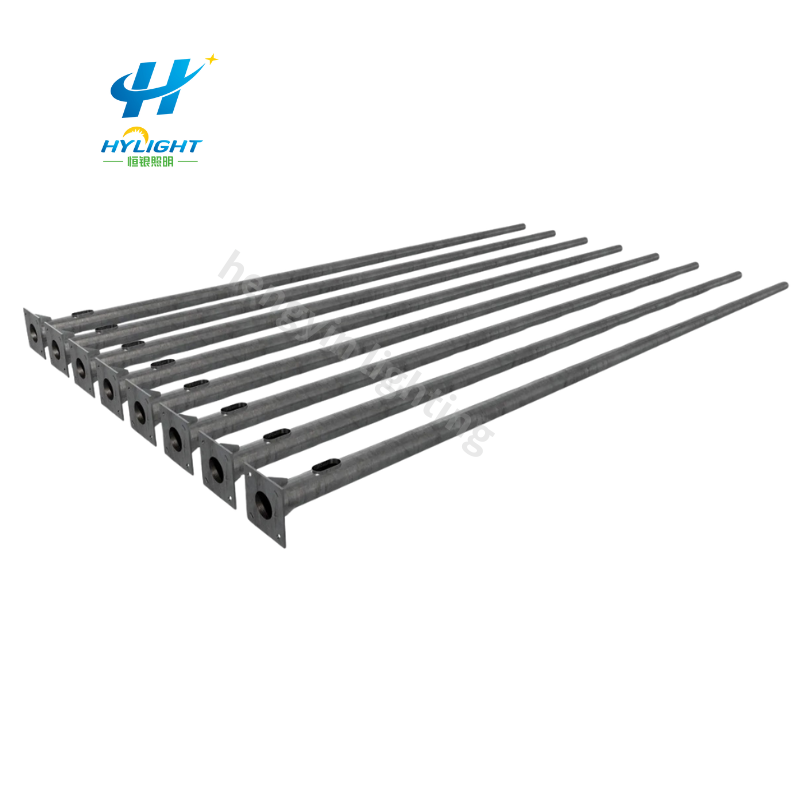
The pole must carry the lamp, panel, arm, and wind load. Hengyin Light’s product path includes solar street light products and solar street light pole products. For engineering orders, the pole should be checked together with panel size and wind speed requirement. Hot-dip galvanizing and powder coating help protect the pole in outdoor environments.
The controller determines charging, discharging, dimming, and battery protection. For project buyers, a clear lighting profile is useful: full power for early evening traffic, lower output after midnight, and stable minimum lighting until morning. This kind of schedule can reduce battery stress while keeping the site useful.
Best For / Suitable For / Not Suitable For
Best for: roads without easy grid access, rural streets, parking lots, parks, industrial compounds, construction camps, ports, community roads, and government energy-saving projects.
Suitable for: contractors, government project suppliers, EPC companies, distributors, solar lighting resellers, and bulk export buyers who can provide project location, quantity, and lighting requirements.
Not suitable for: buyers looking for small garden lamps, decorative balcony lights, one-piece retail replacement, or unrealistic all-night high-power lighting without enough solar panel and battery capacity.
Buyer Need and Product Recommendation Table
| Buyer Need | Recommended Product | Key Specification | Why It Matters |
|---|---|---|---|
| Easy installation | All-in-one solar street light | Integrated lamp, panel, battery, controller | Saves labor for simple roads and parks |
| Higher project flexibility | Split solar street light | Separate panel angle and battery box | Better for larger roads or climate-specific design |
| Higher wind resistance | Customized solar pole | Q235/Q345 steel, thickness, foundation, wind speed | Handles panel load safely |
| Smart energy control | MPPT/PWM controller with dimming | Working mode, autonomy, protection logic | Balances brightness and battery life |
Quality Control and Customization
Quality control should include panel inspection, battery test, controller setting verification, lamp aging test, waterproof inspection, pole welding, galvanizing, powder coating, and packing. For export projects, buyers should also confirm carton size, pole packing, container loading, installation accessories, and spare parts.
Customization can include pole height, color, arm design, solar panel wattage, battery capacity, lighting time, dimming schedule, logo, packaging, and installation drawings. Some projects may add CCTV, WiFi, advertising screen, or smart control modules, but these functions should be evaluated with power budget and pole loading. A smart function that consumes too much energy can reduce lighting stability if it is not designed into the system from the beginning.
RFQ Checklist
For an accurate quotation, please provide project location, target application, required quantity, technical specifications, drawings if available, certification requirements, delivery schedule, and whether OEM/ODM customization is needed.
To receive an accurate quotation, please send us:
- Project country and city
- Road width, pole height, and expected spacing
- Required lighting hours per night
- Required rainy or cloudy backup days
- Lamp wattage or target illumination
- Solar panel and battery preference if already specified
- Quantity, packaging requirement, and destination port
FAQ
What information should I provide before requesting a solar street light quote? Provide project location, road or site type, pole height, road width, quantity, required lighting hours, rainy-day backup requirement, wind speed, and destination country. If drawings or tender specifications are available, send them before quotation so the panel, battery, lamp, and pole can be matched properly.
How do I choose between all-in-one and split solar street lights? All-in-one solar street lights are easier to install and often suitable for smaller roads, parks, and simple projects. Split solar street lights provide more flexibility for panel angle, battery placement, and larger configurations. For larger road projects or difficult climates, split systems may offer better sizing control.
Can solar street lights work during cloudy or rainy days? Yes, if the system is sized correctly. The supplier must calculate battery capacity, solar panel charging, lighting hours, and dimming schedule based on local sunshine and backup days. A low-cost configuration may work in good weather but fail during several cloudy days.
What should distributors check before bulk buying solar street lights? Check product series consistency, battery specification, controller program, pole material, galvanizing, packaging, spare parts, MOQ, lead time, and container loading plan. For repeat business, stable configuration and clear installation documents are more important than a low one-time price.
Image Suggestions
- Solar street light installed on road or parking lot. Alt text: “solar street lights for outdoor road lighting project”.
- Solar panel, battery, and controller detail. Alt text: “solar street light panel battery and controller configuration”.
- Galvanized solar light pole production. Alt text: “solar street light pole factory production for bulk export”.
Internal Link Suggestions
- Solar street light products
- Solar street light pole category
- Integrated all-in-one solar street light
- Contact Hengyin Light
CTA and Lead Qualification Questions
Planning a solar road, parking lot, municipal, or park lighting project? Send us your project country, pole height, lamp wattage, lighting hours, backup days, quantity, and destination port for a customized quotation.
Lead qualification questions:
- What is the project country and installation environment?
- How many lighting sets are required?
- What lighting hours and cloudy-day backup are needed?
- Do you prefer all-in-one or split solar street lights?
- What pole height and wind speed requirement should be considered?
- Do you need OEM packaging, logo, or distributor support?